You wake up with a sore jaw. Breakfast feels annoying instead of easy. By midafternoon, your temples ache, your neck feels tight, and you catch yourself clenching while driving through Quincy or answering emails in Milton. A lot of people on the South Shore live with that pattern for months before they realize their jaw is part of the problem.
If that sounds familiar, you're not alone. TMJ problems can make everyday things feel strangely difficult, from chewing a lobster roll in Plymouth to talking over coffee in Cohasset to bracing your face against the wind at Nantasket. The good news is that jaw pain usually doesn't need a dramatic fix first. In most cases, the smart move is a careful, conservative plan that calms things down, restores motion, and helps you stop feeding the irritation.
Table of Contents
- Living with Jaw Pain on the South Shore
- Why Physical Therapy Is Your Best First Step for TMJ Relief
- Your TMJ Therapy Journey at Peak Physical Therapy
- Supporting Your Recovery with At-Home Care
- Navigating Other TMJ Treatment Paths with Your PT
- Start Your TMJ Recovery on the South Shore Today
Living with Jaw Pain on the South Shore
A lot of TMJ pain starts subtly. Maybe it was a stressful stretch at work. Maybe you've been grinding at night. Maybe your jaw clicks every so often and then one day it doesn't just click, it hurts. You try to ignore it until chewing gets tiring, your face feels tight, or the headaches start showing up more often.

On the South Shore, that can hit during the ordinary parts of life. Dinner out in Duxbury. A long commute from Braintree. A youth sports weekend in Hanover where you're talking all day, clenching in the cold, and finishing the night with jaw soreness that feels way out of proportion.
Temporomandibular disorders, often shortened to TMD, are common enough that they shouldn't be treated like a rare mystery. The National Institute of Dental and Craniofacial Research notes that they're the second most common musculoskeletal condition after chronic low-back pain, are twice as common in women as in men, and affect 5% to 10% of the U.S. population according to NIDCR's overview of temporomandibular disorders.
What jaw pain often feels like day to day
Some people feel it right at the jaw joint. Others mostly notice:
- Morning tightness that makes the first meal of the day uncomfortable
- Clicking or popping that may or may not come with pain
- Headaches near the temples that seem connected to chewing or clenching
- Neck and shoulder tension that builds with desk work or stress
- Fatigue with talking or eating even when the food isn't especially tough
Jaw pain rarely stays just in the jaw. It often shows up as a mix of facial tension, headaches, neck stiffness, and chewing fatigue.
That overlap is one reason people sometimes chase the wrong problem first. If headaches are part of your picture, this guide on physical therapy and migraines can help you understand how head, neck, and jaw symptoms often interact.
It's also worth looking at broader practical resources when you're trying to make sense of day-to-day symptom patterns. Some patients find helpful ideas in articles about addressing TMJ symptoms, especially when they're trying to identify triggers like clenching, poor sleep, or chewing habits.
Why Physical Therapy Is Your Best First Step for TMJ Relief
Typically, TMJ disorder treatment should start with conservative care, not with the most invasive option on the menu. That's not a soft opinion. That's how major medical guidance approaches the problem.
The Mayo Clinic's guidance on TMJ diagnosis and treatment recommends conservative, multimodal care as the first-line approach, including self-management, patient education, and physical therapy exercises that gently stretch and strengthen the jaw muscles. It also notes that most patients improve without surgery.
Why this approach makes sense
A painful jaw is rarely just a hinge problem. The jaw works with the neck, upper back, breathing pattern, posture, and surrounding muscles. If you only chase the click, or only try to numb pain, you can miss the drivers that keep symptoms coming back.
Physical therapy looks at the whole chain. In practice, that often means checking how your head sits over your shoulders, whether your neck is stiff, whether the chewing muscles are overworking, and whether everyday habits are loading the joint more than you realize.
A PT-first approach is useful because it stays reversible, low risk, and adaptable. You can calm irritation, improve motion, and build better mechanics before committing to anything more aggressive.
What physical therapy tends to do well
- Reduce muscle guarding around the jaw, face, and neck
- Improve joint motion when opening or closing feels restricted
- Address posture and movement habits that keep feeding tension
- Teach self-management so you aren't dependent on constant flare-up care
Practical rule: If a treatment can't be adjusted easily and you haven't tried skilled conservative care yet, it's probably too early.
That's also why hands-on care matters. The right manual techniques can help reduce stiffness and improve movement quality without forcing the joint. If you want a better sense of what that type of treatment involves, this overview of manual physical therapy is a good place to start.
What usually doesn't work well is waiting months while clenching, chewing through pain, and hoping it settles on its own. TMJ symptoms often become more stubborn when the irritated tissues and habits have more time to reinforce each other.
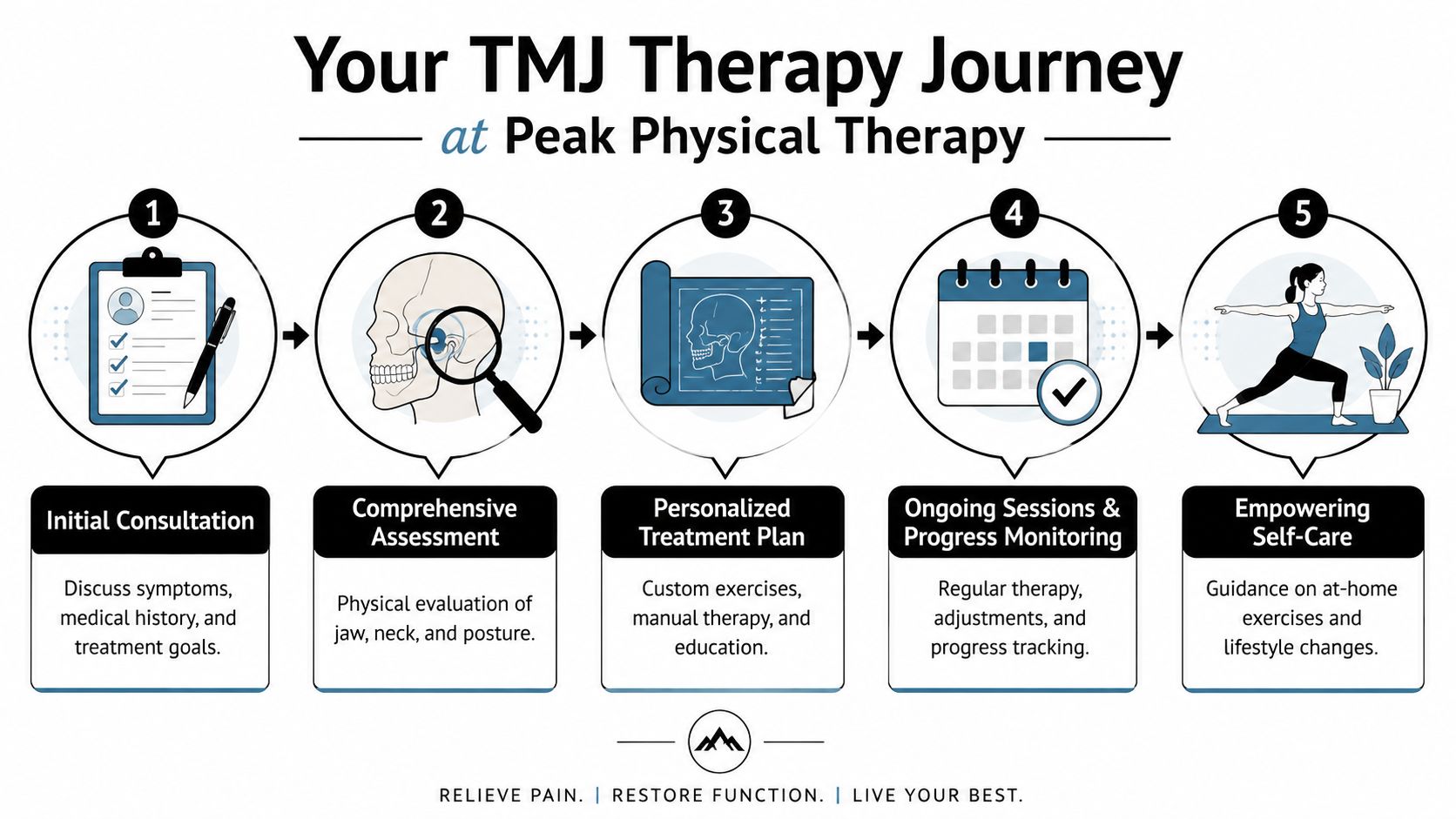
Your TMJ Therapy Journey at Peak Physical Therapy
A common question is simple. What happens when you come in for jaw pain?
The process is usually straightforward. You talk through your symptoms, your therapist looks at how your jaw and nearby areas are moving, and then treatment starts with the least invasive tools that match what you're dealing with.
What happens at the first visit
A good TMJ evaluation doesn't stop at the jaw. Your therapist will typically look at:
- How wide and how smoothly you open
- Whether the jaw shifts to one side during motion
- Tender muscles in the jaw, face, neck, and upper shoulders
- Neck mobility and posture
- Daily aggravators like clenching, gum chewing, hard foods, sleep position, or long computer hours
That matters because two people can both say, "My jaw hurts," and need different care. One may be mostly muscle-driven. Another may be dealing with joint irritation and protective stiffness. A third may have jaw pain tied closely to neck tension and headaches.
What treatment usually includes
Hands-on treatment is often part of the plan. That may include soft tissue work for tight jaw and neck muscles, joint mobilization when motion is limited, and techniques that help the jaw move with less strain. The goal isn't to "crack" the jaw. The goal is to reduce guarding and restore more comfortable movement.
Exercise is the second piece. Early exercises are usually gentle and specific, not aggressive. Depending on what your therapist finds, you may work on:
- Controlled opening and closing to improve coordination
- Tongue placement drills that help the jaw move more smoothly
- Postural correction work for the neck and upper back
- Relaxation and awareness strategies to reduce daytime clenching
A plan may also include education about eating, speaking, sleeping, and pacing. That advice sounds simple, but it's often what helps treatment stick between visits.
Some of the fastest wins in TMJ care come from changing the small things you do all day, not just the exercises you do for five minutes.
Peak Physical Therapy and Sports Performance offers this kind of TMJ-focused physical therapy across the South Shore, with care built around examination, manual treatment, exercise, and home strategies rather than a one-size-fits-all jaw protocol.
By the first few visits, patients often have a clearer picture of what is irritating the jaw, what calms it down, and which habits need to change. That clarity alone is a relief when you've been guessing for weeks.
Supporting Your Recovery with At-Home Care
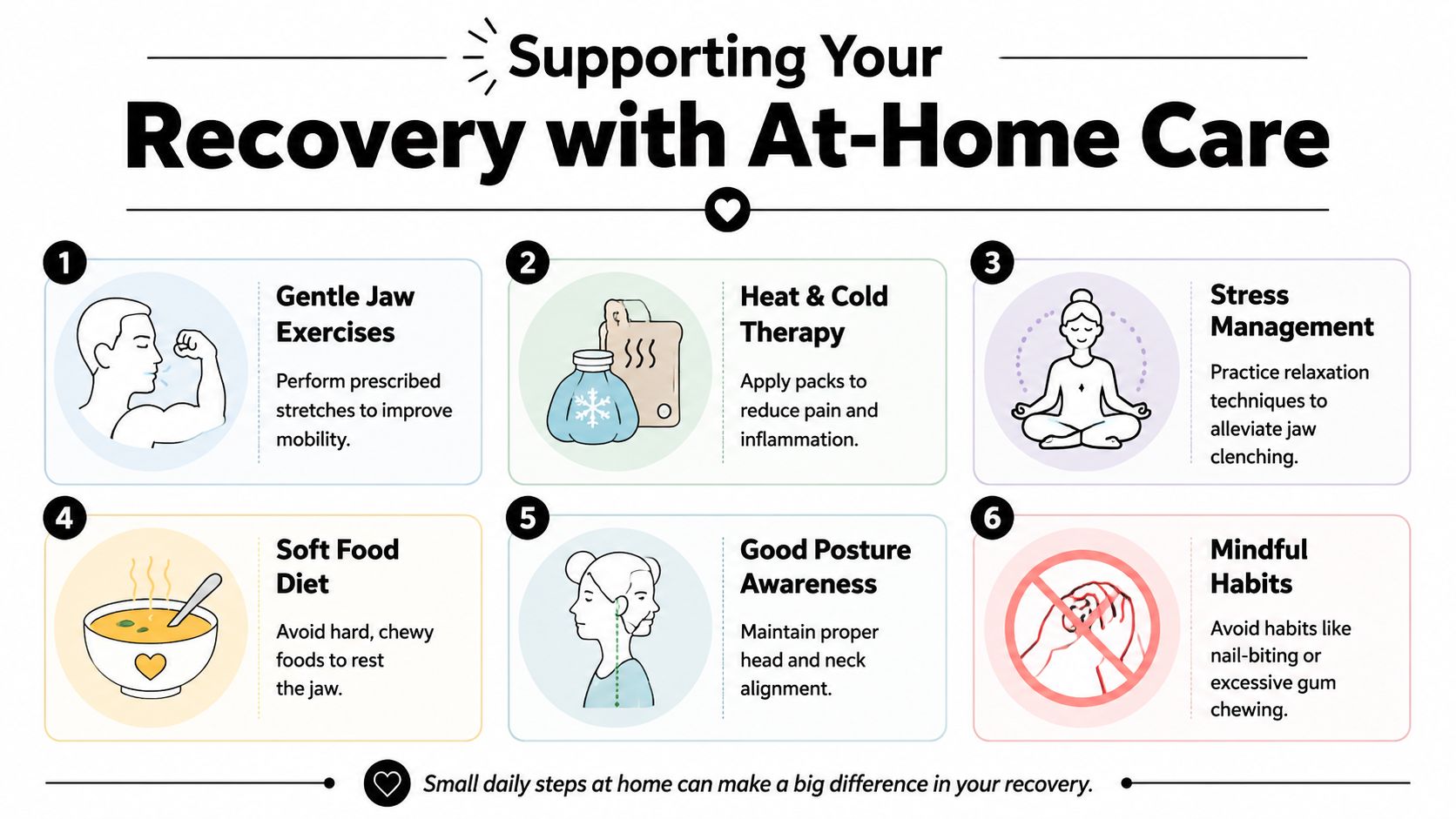
Clinic treatment helps, but what you do between visits matters just as much. A jaw that's irritated by clenching, poor posture, hard chewing, and tension all day won't stay calm for long unless those habits change too.
The good news is that home care doesn't need to be complicated. It needs to be consistent.
Simple habits that reduce flare-ups
Start with the basics that take stress off the jaw during the day:
- Keep your teeth apart at rest unless you're chewing or swallowing
- Let your tongue rest lightly on the roof of your mouth if your therapist recommends it
- Check your posture during computer work, driving, and scrolling on the couch
- Use heat or cold based on what your therapist suggests for your symptoms
- Avoid gum chewing, nail biting, and jaw popping on purpose
For desk workers in Quincy, Braintree, or Milton, posture is a big one. Forward head posture can load the neck and jaw together. A simple reset helps. Sit tall, soften your ribs, and bring your head back over your shoulders instead of reaching your chin toward the screen.
A calm jaw usually hangs out in a calm body. If your neck, shoulders, and breathing stay tense all day, your jaw often follows.
Nighttime grinding can be part of the picture too. If you suspect that's happening, it can help to review practical tips for stopping teeth grinding and then discuss what fits your symptoms with your PT, dentist, or both.
What to eat and what to avoid for now
You don't need to panic about food, but a flared jaw usually appreciates a temporary break from heavy chewing.
A short-term soft-food approach often means choosing items that are easier on the joint, such as softer proteins, soups, yogurt, eggs, cooked vegetables, pasta, rice dishes, or flaky fish. On the South Shore, that might mean skipping the extra-chewy bagel for now, cutting food into smaller bites, or choosing a softer seafood dish instead of something that demands a lot of force.
Try to avoid:
- Very chewy foods like tough breads or chewy candy
- Large bites that force a wide opening
- Crunchy snacks if they reliably trigger soreness
These aren't forever rules. They're a way to reduce irritation while the jaw settles and movement improves.
Navigating Other TMJ Treatment Paths with Your PT
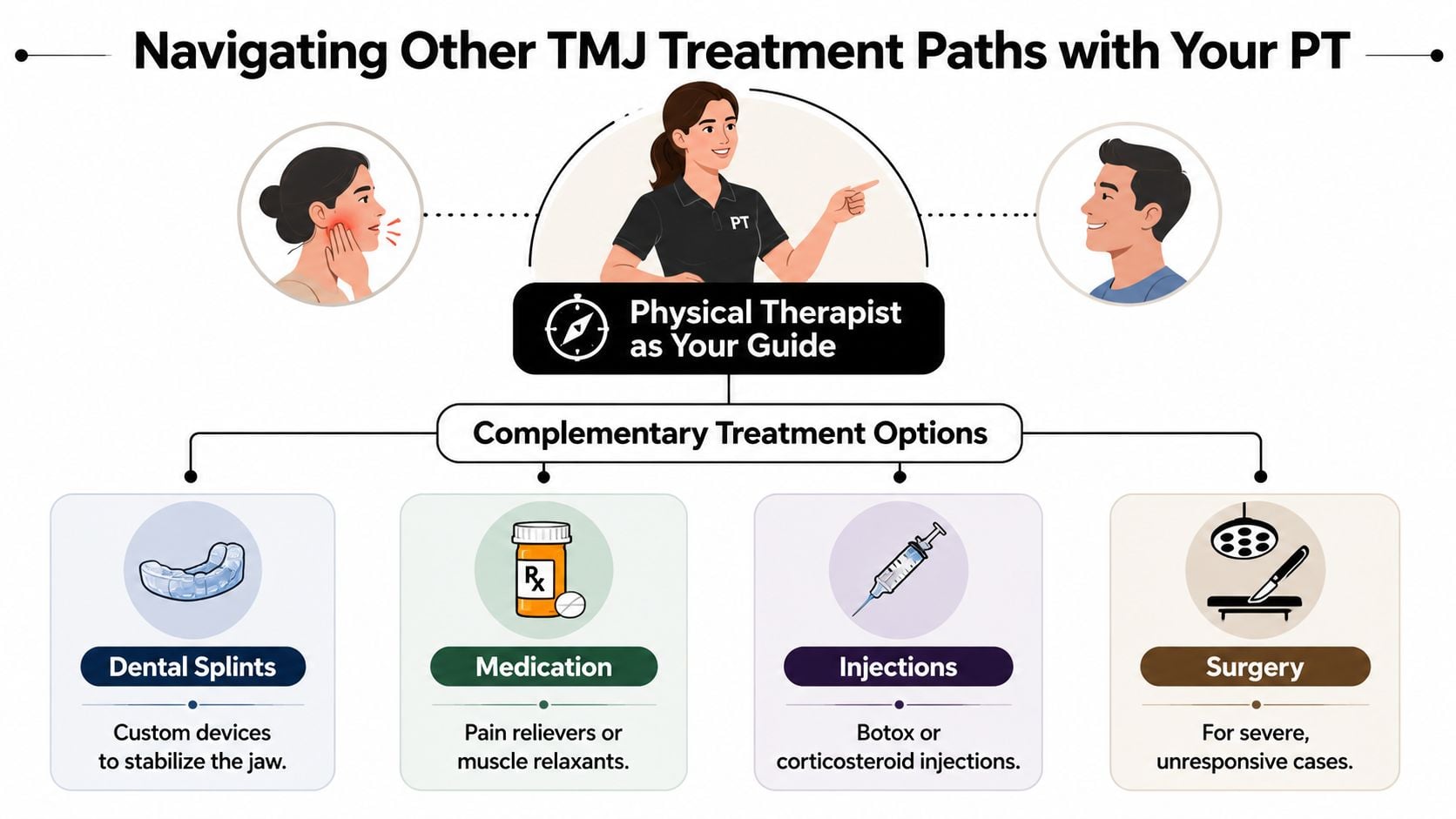
Conservative care doesn't mean ignoring every other option. It means using the right order. A physical therapist can help you sort out when self-care and rehab are enough, when a dental opinion makes sense, and when more specialized medical evaluation is appropriate.
That matters because TMJ symptoms don't come from one single cause. Some cases are mostly muscular. Some are more joint-focused. Some involve clenching, sleep issues, arthritis, or bite-related concerns. The treatment path should follow the presentation, not the other way around.
When dental or medical support makes sense
Sometimes another provider belongs on the team. A dentist may help if nighttime grinding, tooth wear, or a splint discussion is part of the picture. A physician may help when medication is needed to calm a painful flare. In some cases, an oral and maxillofacial specialist may need to assess persistent joint locking, major mechanical symptoms, or trauma-related problems.
For a general explanation of what patients often look for when they start searching for specialty care, articles on finding a TMJ specialist in Memphis can be useful as a broad example of how people compare provider roles, even though the practical next step on the South Shore is getting the right local evaluation first.
If you want a deeper educational overview beyond this local guide, Highbar Health has broader condition resources at highbarhealth.com.
What usually is not the first move
Surgery is rarely the opening play. The American Academy of Family Physicians states that most patients can be treated satisfactorily without surgery, and that surgery is generally reserved for trauma-related fractures or severe pain and joint dysfunction that persists for more than 3 to 6 months despite conservative management, as outlined in the AAFP review on temporomandibular disorders.
That same stepwise thinking applies to irreversible dental changes. Patients are often surprised to learn that bite changes, orthodontics, or other permanent interventions are not automatic answers for jaw pain. When symptoms are driven by muscle tension, coordination problems, joint irritation, or neck mechanics, those routes may not solve the underlying problem.
A sensible progression usually looks like this:
| Option | When it may fit |
|---|---|
| Physical therapy and self-care | Early care, muscular pain, stiffness, clenching patterns, neck-related contributors |
| Dental support such as splints | Teeth grinding, protection needs, selected cases where a dentist sees clear value |
| Medication or injections | Pain control in more reactive cases, usually as part of a larger plan |
| Surgical consultation | Trauma, severe dysfunction, or symptoms that remain significant after appropriate conservative care |
Start Your TMJ Recovery on the South Shore Today
If your jaw has been clicking, aching, locking, or feeding headaches and neck tension, you don't need to keep guessing. The most useful first step is usually a conservative evaluation that looks at the jaw, the neck, your habits, and the movement patterns that may be keeping the problem alive.
Around the South Shore, convenience matters. When care is close to home, it's easier to follow through and easier to get help before a mild problem turns into a stubborn one. Whether you're in Quincy, Weymouth, Hanover, Plymouth, Kingston, Pembroke, or Scituate, there are local options for getting started without jumping straight to invasive care.
If you're also comparing neighborhood options for rehab more broadly, this guide to physical therapy near me on the South Shore can help you think through what to look for in a clinic close to home.
Find Your Local Peak Physical Therapy Clinic
| Town | Services Offered |
|---|---|
| Braintree | Orthopedic physical therapy, TMJ care, headache and neck treatment |
| Quincy | Orthopedic physical therapy, jaw pain care, postural and manual therapy |
| Weymouth | TMJ-focused physical therapy, neck pain treatment, exercise-based rehab |
| Cohasset | Orthopedic rehabilitation, manual therapy, movement-based care |
| Duxbury | Jaw pain treatment, sports and orthopedic physical therapy |
| East Bridgewater | Orthopedic rehab, chronic pain support, therapeutic exercise |
| Hanover | TMJ care, neck and headache treatment, functional rehab |
| Kingston | Orthopedic physical therapy, manual care, home exercise guidance |
| Milton | Postural care, neck and jaw treatment, personalized rehab |
| Norwell | TMJ treatment, orthopedic rehab, mobility and stability training |
| Pembroke | Physical therapy for jaw, neck, and musculoskeletal pain |
| Plymouth | Orthopedic rehab, TMJ support, return-to-activity care |
| Scituate | Jaw pain treatment, movement restoration, personalized PT plans |
You may not need a dramatic procedure. You may need the right plan, applied consistently, by someone who knows how the jaw, neck, and posture work together.
If jaw pain is making meals, sleep, work, or conversation harder than they should be, schedule an evaluation with Peak Physical Therapy and Sports Performance. With clinics across the South Shore, it's easy to book close to home and start a practical, PT-first plan for TMJ relief.