


If you're dealing with the sharp, radiating pain of a herniated disc, you likely feel frustrated and worried. The good news is that the most effective first step is often targeted, non-surgical therapy for a herniated disc. This structured, evidence-based approach helps the vast majority of people find lasting relief and get back to their lives without invasive procedures.
Your Path to Relief from Herniated Disc Pain

Hearing the words "herniated disc" can be alarming, bringing up fears of chronic pain and major surgery. We understand. You're not just dealing with the physical pain; you're dealing with the frustration of missing out on activities you love, the anxiety about your future, and the exhaustion from disrupted sleep.
It helps to picture a herniated disc like the jelly filling of a donut being squeezed out. When that "jelly" presses on a sensitive nerve, it causes the classic symptoms of sharp, shooting pain (often called sciatica), numbness, or weakness that can travel down your arm or leg. It can make simple tasks like sitting through your commute from the South Shore to Boston, or even just tying your shoes, feel impossible.
Hope And Healing Without Surgery
Let's start with some reassuring news. The idea that surgery is the only answer for a herniated disc is a common myth. In reality, conservative care led by a licensed physical therapist is the proven first-line treatment.
This isn't just an opinion; extensive clinical data shows that around 90% of patients improve significantly without needing an operation. Most people see major relief within 6 to 12 weeks using evidence-based approaches like targeted exercises and lifestyle adjustments.
To help you visualize the journey, here’s a quick overview of what to expect from non-surgical herniated disc therapy.
Your Herniated Disc Recovery Quick Guide
| Recovery Stage | Typical Timeline | Primary Goal |
|---|---|---|
| Initial Assessment & Pain Relief | Weeks 1-2 | Calm inflammation, centralize pain, and identify movements that bring relief. |
| Mobility & Core Activation | Weeks 3-6 | Gently restore spinal movement, activate deep core muscles, and improve posture. |
| Strengthening & Functional Movement | Weeks 7-12+ | Build strength to support the spine, practice safe lifting/bending, and return to daily activities. |
This structured approach is what makes physical therapy so effective. Our licensed physical therapists perform a comprehensive evaluation to determine the root cause of your pain and develop a personalized treatment plan—we're not just masking the pain, we're addressing the underlying problems that caused it.
How Physical Therapy Works
Physical therapy for a herniated disc is a multi-faceted approach designed to promote natural healing and prevent future issues. It focuses on:
- Reducing Nerve Pressure: We use gentle, specific movements to help centralize the pain, moving it out of your leg or arm and back toward its source where it can be managed more effectively.
- Strengthening Your Core: We’ll help you build a natural "corset" of muscle support around your spine, which offloads the damaged disc and prevents future strain.
- Improving Mobility: Hands-on manual therapy can restore movement to stiff spinal joints and release painfully tight muscles, which are often compensating for the injury.
- Empowering You with Education: You will learn safe ways to move, lift, and sit, giving you the confidence to manage your condition independently and get back to life.
At Peak Therapy, our Massachusetts-based specialists create personalized recovery plans designed to get you back on your feet. Small changes at home, like understanding the benefits of a firm mattress for spinal health, can also make a big difference. Our goal is to give you a clear, structured, and non-surgical path to reclaim your life from pain.
What to Expect at Your First Physical Therapy Visit

Walking into your first physical therapy appointment can feel a little intimidating, especially when you’re already in pain. You might be wondering what to expect or if it will make your pain worse. At Peak Therapy, our first goal is simple: to make you feel heard, understood, and confident that you’re on the right path.
Before we even think about treatment, we need to understand exactly what’s going on with you. Your initial visit is all about a comprehensive evaluation. This isn’t some quick, one-size-fits-all checklist; it's a deep dive to find the root cause of your pain so we can build a therapy for a herniated disc that actually works for you.
The Conversation: Your Story Matters
The most important part of your first visit is the conversation. Your licensed physical therapist will sit down with you and listen. We want to hear your story, in your own words.
This discussion helps us build a complete picture of your condition and, more importantly, how it’s affecting your day-to-day life. We’ll cover things like:
- Your Pain History: When did this start? What does it feel like—is it a sharp pain, a dull ache, or more of a burning or tingling feeling? Where exactly is the pain, and does it seem to travel?
- Impact on Your Life: We need to know what this pain is costing you. Is it making it tough to get through your workday in downtown Boston? Are you missing out on weekend hikes at Blue Hills Reservation? Is lifting your child or playing with your grandkids becoming a struggle?
- Your Personal Goals: What does “getting better” mean to you? Is it getting back on the golf course, running the Falmouth Road Race, or simply being able to sleep through the night without pain? Your goals drive the entire recovery process.
We believe in treating people, not just MRIs. An imaging report provides a snapshot, but your story, your symptoms, and your goals tell us what truly matters for your recovery. This philosophy guides every personalized plan we create at our clinics across Massachusetts.
The Physical Assessment: Finding the Root Cause
After we’ve listened to your story, your physical therapist will guide you through a physical assessment. This is a hands-on process designed to pinpoint the specific mechanical issues that are causing your pain. It’s a crucial step in confirming the diagnosis and ruling out any other possibilities.
Your therapist will take you through a series of gentle movements and tests to check a few key things:
- Range of Motion: We’ll see how far you can comfortably move your spine in different directions. This helps us understand which movements are limited by pain or stiffness.
- Muscle Strength: We will test the strength in your core, back, and leg muscles. This helps us find any weaknesses that might be making your spine less stable.
- Reflexes and Sensation: Using gentle tests, we check your reflexes and sensation to see if, and how, the herniated disc is impacting your nerves.
- Orthopedic Tests: Your therapist will perform specific movements and apply light pressure to zero in on the exact source of your pain. This is a key part of creating an effective therapy for a herniated disc.
This detailed assessment is what allows us to build a precise and effective treatment plan from day one. It often involves a mix of hands-on techniques, which you can read more about in our guide to manual physical therapy, and specific exercises. Your recovery plan is built around you—your body, your life, and your goals—ensuring you get truly personalized care, whether you see us in Braintree, Quincy, or Plymouth.
Core Techniques in Physical Therapy for Herniated Discs
Once our licensed physical therapists complete a thorough evaluation, we can put your personalized plan into action. Your recovery will be built around a few proven techniques that work together to not only provide relief but also address the underlying problem. Our goal is to restore your function and build resilience so you don’t have to deal with this again.
This active phase of therapy for a herniated disc is a team effort between you and your physical therapist. We combine hands-on care to calm your immediate symptoms with targeted exercises to rebuild support, all while giving you the knowledge you need for long-term success.
Let's break down the core components you can expect when you come into our Peak Therapy clinics.
Manual Therapy: Hands-On Relief
Manual therapy is a cornerstone of effective herniated disc treatment, and it’s something we specialize in. It involves skilled, hands-on techniques our licensed physical therapists use to reduce your pain and help you move better. Think of it as a way to "reset" the painful area, creating a window of opportunity for healing and exercise.
It's a common fear that this has to be painful. Our therapists are trained to work gently and precisely, always communicating with you to make sure you’re comfortable.
Key manual therapy techniques we use include:
- Soft Tissue Mobilization: Your therapist will use targeted massage and other hands-on methods to release tension in the tight, painful muscles around your spine. These muscles often go into a protective spasm with a disc injury, so releasing them can bring immediate relief.
- Joint Mobilization: This involves gentle, passive movements of your spinal joints. The goal here is to restore normal motion, reduce stiffness, and help take pressure off the irritated disc and nerve.
It's important to understand that these techniques don't "push the disc back in." Instead, they create a much better environment for your body to heal by calming pain signals, improving circulation, and restoring proper movement to the spine.
Therapeutic Exercise: Building Your Foundation for Recovery
While manual therapy gives you that initial relief, therapeutic exercise is what builds lasting strength and stability. This is where you become an active partner in your own recovery. Your therapist will guide you through a progressive program of specific exercises designed to support your spine and prevent this from happening again.
Your core is your body’s natural back brace. A weak core forces the small muscles and discs in your spine to do work they were never designed for. Building a strong, stable core is one of the most important things you can do to protect your back for life.
Your exercise plan will always be customized to you, but it will likely focus on three critical areas:
- Core Stabilization: We're not talking about endless crunches. We focus on activating the deep, internal muscles of your abdomen and back that form a supportive "corset" around your spine. Strengthening this system is fundamental to taking the load off an injured disc. We've written a detailed guide with some foundational core strengthening exercises for your back if you want to learn more.
- Directional Preference Exercises: Based on your initial assessment, we’ll identify specific movements that help "centralize" your pain—that is, move it out of your leg or arm and back toward your spine. A well-known approach for this is the McKenzie Method, which often uses repeated movements like gentle back extensions to help guide the disc material away from the nerve root.
- Nerve Glides (or Nerve Flossing): When a nerve is pinched, it can become "stuck" or irritated by the tissues around it. Nerve glides are very gentle, controlled movements designed to slowly and carefully free up the nerve, allowing it to move smoothly again and reducing symptoms like numbness or tingling.
Patient Education: Your Plan for Long-Term Success
Finally, one of the most crucial parts of your physical therapy is simply learning about your body. We believe that understanding what’s going on is the key to managing it successfully. We want you to leave our clinic feeling confident and empowered, not dependent on us.
Think of your physical therapist as your personal health coach. We'll teach you:
- Posture and Body Mechanics: We’ll show you how to sit, stand, bend, and lift safely to minimize strain on your back. This is especially important for our Massachusetts clients who have long commutes or jobs that require a lot of repetitive movement.
- Pain Management Strategies: You'll learn exactly what to do when you have a flare-up, including how to use heat or ice correctly and which gentle movements can provide fast relief.
- Activity Modification: We'll help you figure out how to stay active without making things worse. We find ways to modify the activities you love so you can keep doing them safely.
These three pillars—manual therapy, therapeutic exercise, and patient education—work together seamlessly. They create a clear and effective path to guide you from debilitating pain back to a full, active life.
Mapping Your Herniated Disc Recovery Timeline
When you're dealing with the intense pain of a herniated disc, it's easy to feel lost. The uncertainty of how long it will last can be just as frustrating as the pain itself. Having a clear roadmap for recovery helps you set realistic goals, track your progress, and stay motivated.
While everyone's healing journey is a little different, recovery from a herniated disc usually follows a predictable, three-phase path. At Peak Therapy, we guide our patients through each stage, personalizing the plan based on how your body is responding.
This timeline breaks down what you can generally expect as you move from initial pain relief to getting back to your life.
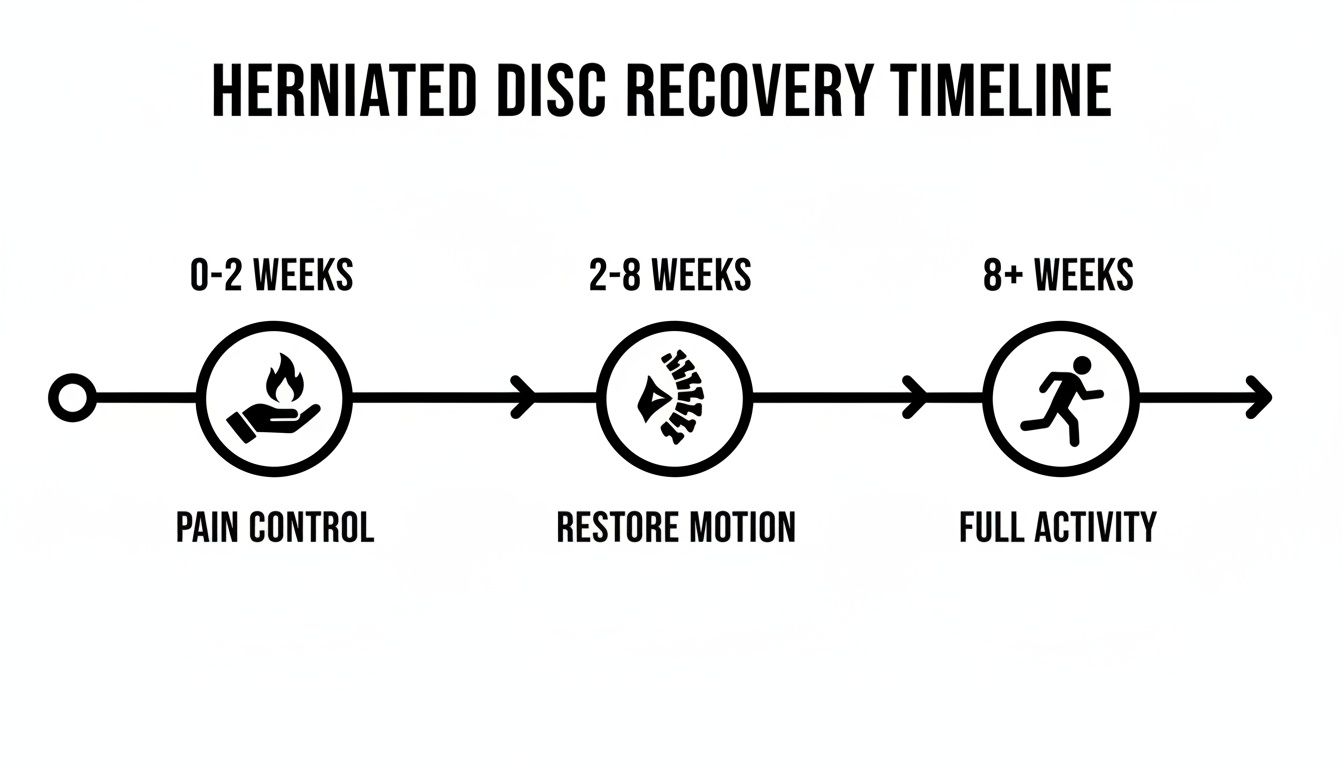
The big takeaway here is that healing isn't about pushing through pain. It’s about smart, progressive steps that allow your body to heal properly.
Phase 1: The Calm-Down Phase (Weeks 1-2)
The first one to two weeks are all about getting your acute symptoms under control. The goal is simple: calm everything down. We need to reduce the pain and inflammation so your body has a chance to start healing.
During this initial phase, your therapy for a herniated disc is focused on relief. We’ll help you with:
- Gentle, Pain-Free Movements: We'll find the specific motions that help "centralize" your pain, which means moving it out of your arm or leg and back toward your spine. This is a huge sign of progress.
- Pain Relief Strategies: This might involve hands-on manual therapy to ease muscle guarding, or using modalities like ice or heat to soothe irritated tissues.
- Finding Comfortable Positions: We'll teach you the best ways to sit, stand, and sleep to take pressure off the injured disc and give your body a break.
This phase is not about being aggressive; it’s about finding what feels good and creating a safe foundation to build upon.
Phase 2: The Restoration Phase (Weeks 3-6)
Once the initial, intense pain has subsided, we can shift our focus to getting you moving again. The goal here is to restore your spine's natural mobility and start building the core strength needed to protect it. This is when you'll really start to feel more confident and capable.
Your physical therapist will begin to progress your program to include:
- Restoring Your Range of Motion: We use a combination of specific stretches and hands-on therapy to gently improve how your spine and hips move.
- Waking Up Your Core: You'll learn how to properly turn on your deep core muscles—the body's "natural back brace"—to provide stability.
- Improving Nerve Mobility: For any lingering numbness or tingling, we may add in gentle nerve gliding exercises to help the nerve slide and move freely again.
This is the phase where you build true resilience and start bulletproofing your back against future problems.
Phase 3: The Return-to-Life Phase (Weeks 7-12+)
Now for the best part—getting back to your life. With your pain managed and your core firing correctly, the goal is to return to all the activities you love without worrying about re-injury. Whether that's golfing at a local Massachusetts course, playing with your grandkids, or gardening, this is where we prepare you for it.
In this final phase, your therapy for a herniated disc will involve:
- Advanced Strengthening: Exercises become more dynamic, challenging your back and core in ways that mimic real-world movements.
- Simulating Your Activities: We'll practice the specific motions related to your job, sport, or hobbies to ensure your body is ready for the demand.
- Creating a Long-Term Game Plan: You'll "graduate" from therapy with a personalized home program to maintain your strength and know exactly what to do if you ever feel a twinge.
This structured, conservative approach works. A massive review following over 39,000 patients for an average of six years found that 78.9% reported good to excellent results with conservative care alone. It's powerful evidence that most people can find lasting relief without needing surgery. You can read the full findings in this extensive review on herniated disc treatment outcomes.
When to Consider Surgery or Other Interventions
At Peak Therapy, we see ourselves as your trusted guide on the road to recovery. That means having an open and honest conversation about all your treatment options, including knowing when physical therapy needs support from other medical interventions. Our top priority is helping you achieve the best possible outcome, and sometimes that means working together with other specialists.
While the vast majority of herniated discs respond incredibly well to conservative care, there are a few specific "red flag" symptoms that signal a need for immediate medical attention. These are rare, but it's vital to know what to look for.
- Progressive Leg Weakness: If you notice your foot starting to "drop" when you walk or find yourself tripping because a leg is giving out, it’s time to seek medical care right away.
- Loss of Bowel or Bladder Control: The sudden inability to control your bladder or bowels is a medical emergency known as Cauda Equina Syndrome.
- Saddle Anesthesia: This refers to numbness or a complete loss of sensation in the areas that would touch a saddle—your inner thighs, groin, and buttocks.
If you experience any of these symptoms, please head to the nearest hospital emergency room, like the one at South Shore Hospital or Beth Israel Deaconess Hospital-Milton, for an urgent evaluation.
When a Surgical Consultation Makes Sense
For most people, surgery isn't the first step. In fact, a massive real-world study of over one million patients with lumbar disc herniation found that 98.4% started with conservative care like physical therapy. Only a small fraction, about 10.6%, eventually had surgery within three months, which really highlights just how effective non-surgical treatment can be. You can dive into the data from this patient study on lumbar disc herniation treatment paths.
So, when is it time to talk about surgery? A surgical consultation is typically recommended only after a dedicated course of conservative treatment—usually 3 to 6 months of consistent physical therapy—hasn’t produced the desired results. If your pain remains severe and keeps you from living your life despite your best efforts in therapy, discussing surgical options with a specialist is a perfectly reasonable next step.
Navigating the decision between continuing with therapy and seeking a surgical opinion can be confusing. This table helps clarify some common scenarios to guide your conversation with your physical therapist.
Conservative Care vs. Surgical Consultation
| Symptom / Scenario | Recommended Action: Continue PT | Recommended Action: Consider Consultation |
|---|---|---|
| Pain is improving, even slowly | Your body is responding to treatment. Stick with your program to build on this progress. | Not applicable. Progress is a great sign! |
| Pain is severe after 3-6 months of consistent PT | We can explore different PT techniques or adjunct therapies to break the plateau. | If pain remains debilitating and limits all daily function, it's time to discuss surgical options with a specialist. |
| Numbness/tingling is decreasing or centralizing | This is a positive sign that nerve pressure is decreasing. Continue with your exercises. | Not applicable. Centralization is a key goal of therapy. |
| Weakness is stable or improving | Strength is returning as the nerve heals. Your strengthening program is working. | If weakness is getting progressively worse (e.g., foot drop) despite therapy, an urgent surgical opinion is needed. |
| Flare-ups occur but are manageable and less frequent | Flare-ups are a normal part of healing. We'll teach you how to manage them and adjust your activities. | If flare-ups become more frequent, more intense, and are no longer responding to your management strategies, a consultation is reasonable. |
| You are gaining function and returning to activities | You are on the right track! The goal is to keep building strength and resilience to prevent future issues. | Not applicable. Functional improvement is the primary goal of conservative care. |
Ultimately, the decision is a collaborative one between you, your physical therapist, and your doctor. This table is just a starting point for that important conversation.
How Other Interventions Complement Physical Therapy
Surgery isn’t the only other path. In fact, certain medical interventions can work hand-in-hand with your physical therapy to help you recover faster. For instance, an epidural steroid injection (ESI) delivers powerful anti-inflammatory medication right to the source of the nerve irritation.
An ESI doesn't "fix" the herniated disc itself, but it can dramatically dial down the pain and inflammation. This creates a valuable "window of opportunity," making it much more comfortable for you to fully engage in your physical therapy exercises and see better, faster results.
When muscle spasms and stubborn knots are part of the problem, your doctor might suggest other options like Trigger Point Injections with Lidocaine to relieve the localized muscle pain that often comes with a disc injury. Our team at Peak Therapy regularly collaborates with pain management doctors and orthopedic surgeons across Massachusetts to make sure your care plan is coordinated, effective, and built just for you.
Find Expert Herniated Disc Therapy in Massachusetts
You now have a solid understanding of what causes a herniated disc, its symptoms, and the proven treatments that bring relief. The next step—and the most important one—is to partner with the right expert to guide your recovery. Your journey back to a life without pain starts by connecting with someone who truly understands your specific needs and goals. That’s where the compassionate, licensed therapists at Peak Therapy come in.
We’re proud to serve communities all across Massachusetts, with convenient locations in Quincy, Braintree, Weymouth, Duxbury, Cohasset, and beyond. Our team doesn't just treat back pain; we treat the person experiencing it. Because we live and work here too, we understand the unique challenges our neighbors face.
Local Care for Your Massachusetts Lifestyle
Maybe you’re a weekend warrior who tweaked your back doing yard work in Hanover, or a daily commuter whose sciatica flares up on the train into Boston. We understand how frustrating it is when pain stops you from enjoying a walk through Wompatuck State Park or playing with your kids at Webb Memorial State Park.
Our approach to therapy for a herniated disc is built on this local understanding. We don’t use a one-size-fits-all model; our licensed physical therapists create personalized plans designed for real life right here in our communities.
We understand how debilitating back pain can be and how it can make you feel stuck. Our entire team is dedicated to one goal: helping you get back to the life you love, with less pain and more confidence.
Take the First Step Toward Relief Today
Living with the constant worry of a herniated disc is exhausting. You’ve already done the hard work of educating yourself, and now it’s time to take action. Don't let pain dictate your life for another day. Getting the expert help you need is much easier than you might think.
At Peak Therapy, we make it simple to get started:
- Schedule Online with Ease: You can book your initial evaluation at any of our convenient Massachusetts locations directly from our website.
- Verify Your Insurance Instantly: Our online tool lets you check your insurance coverage in just a few clicks, so there are no surprises.
The path to relief is clear. Let our expert physical therapists perform a comprehensive evaluation to find the root cause of your pain and build a recovery plan that actually works for you. Schedule your evaluation today and start your journey back to feeling your best.
Common Questions About Herniated Disc Therapy
It’s completely normal to have questions when you’re starting therapy for a herniated disc. You’re likely hopeful about feeling better but might also be a little nervous about what to expect. We hear these questions all the time in our Massachusetts clinics, so we wanted to answer them directly to give you confidence as you get started.
Will Physical Therapy for My Herniated Disc Be Painful?
That’s a very common worry, but our first goal is actually to get you out of pain, not cause more of it. Our physical therapists at Peak are experts in pain science and always start with gentle techniques that stay well within your comfort zone.
You might feel a “good stretch” or the sensation of a muscle working, but you should never feel sharp or increasing pain. We’ll be checking in with you constantly during your session and will adjust your treatment on the spot to make sure everything we do is helping, not hurting.
Do I Need an MRI Before Starting Physical Therapy?
For the vast majority of herniated discs, the answer is no. A thorough physical exam with one of our experienced therapists gives us everything we need to pinpoint the problem and create an effective treatment plan. We look at your movement, strength, reflexes, and symptoms to find the real source of your pain.
It's important to know that disc bulges and herniations are often found on MRIs of people who have absolutely no pain. This is why we live by a simple philosophy: "Treat the person, not the scan." Your symptoms are what guide your recovery, not just a picture.
If our licensed therapists do spot any "red flag" symptoms during your evaluation that might point to a more serious issue, we won't hesitate to refer you to the right medical specialist for a closer look.
Can I Still Exercise with a Herniated Disc?
Yes, you can—and you absolutely should! The right kind of exercise is one of the most important parts of getting better. The old advice of complete bed rest has been proven to slow down healing and can actually lead to more stiffness and weakness down the road.
Your physical therapist will be your guide, giving you a specific, safe exercise program designed to build core strength, improve spinal stability, and take pressure off the nerve. We’ll also give you clear advice on which activities to put on hold for a bit—like heavy lifting or high-impact running—to give your body the best chance to heal. Since sciatica is often the main symptom, learning how to manage it is crucial. You can learn more in our guide on how to relieve sciatica pain.
How Long Until I Feel Better?
Everyone’s recovery timeline is a little different, but most of our patients start feeling a real drop in their pain within the first 4 to 6 weeks of consistent physical therapy. And the research backs this up—studies show that between 85% and 90% of people with herniated discs get significantly better within 6 to 12 weeks with conservative care like PT.
Getting back to 100%—whether that’s returning to your favorite sport, running along the Charles River, or just lifting your kids without worry—usually happens around the 3-month mark. Your commitment to the program and your body's own healing process are the biggest factors in how quickly you progress.
The journey to recovery starts with a single, confident step. At Peak Physical Therapy, our dedicated team across Massachusetts is ready to help you leave pain behind and get back to the life you love. Don’t wait to feel better. Schedule your evaluation at a clinic near you today.