


If you’re struggling with the sharp, radiating pain of sciatica, you’re not looking for more questions—you want a straight answer. So, can physical therapy help sciatica? Yes, absolutely. In fact, physical therapy is one of the most effective, evidence-based treatments because it addresses the root cause of your pain, unlike medications that just mask the symptoms.
We understand how frustrating and frightening this pain can be. It stops you from living your life, whether that’s commuting into Boston, playing with your kids in a Duxbury park, or just getting a good night's sleep. The fear of it getting worse or needing surgery is real. This guide will walk you through how our licensed physical therapists at Peak Therapy develop personalized plans to deliver lasting relief, without surgery or medication.
The Definitive Answer: How Physical Therapy Delivers Lasting Sciatica Relief

When sciatica strikes, it can feel like your own body has turned against you. That shooting pain traveling from your lower back down your leg can make simple things—like sitting through a commute on the I-93 or walking the dog—feel impossible. You start to worry about missing work, giving up your favorite hobbies, or even facing the prospect of surgery. It’s a frustrating and often frightening experience.
We want to reassure you: a proven, non-surgical path to lasting relief exists. Physical therapy isn’t just a list of generic exercises; it's a personalized treatment plan designed by a licensed therapist to address the specific reason your nerve is so irritated.
A Proven Approach to Treating the Root Cause
Unlike pain medications that only offer temporary relief by dulling the symptoms, physical therapy aims to solve the underlying mechanical problem. Our licensed physical therapists perform a comprehensive evaluation to determine the root cause of your sciatica and develop a personalized treatment plan.
Your plan will focus on a few key goals:
- Reducing Nerve Compression: We use gentle, specific movements and hands-on techniques to create more space around the sciatic nerve, which calms down the irritation and pain.
- Calming Inflammation: Targeted therapies and movements help decrease the inflammatory response that’s contributing to your discomfort.
- Strengthening Support Muscles: Building strength in your core, glutes, and back creates a natural “corset” that protects your spine from future strain and flare-ups.
You shouldn't have to stop doing what you love because of sciatica. A strategic physical therapy program is a safe, effective way to treat the cause of your pain and help you get back to the activities you enjoy in your Massachusetts community.
Backed by Clinical Evidence
The success of physical therapy for sciatica isn't just a hopeful promise; it's supported by solid research. A major systematic review confirmed that while many things can help in the short term, physical therapy provides a significant edge for long-term pain reduction. Patients in the study had noticeably less leg pain over time compared to those who didn’t get targeted PT.
You can review the research on long-term physiotherapy benefits and see the data for yourself. This guide will explain exactly how a tailored plan from our expert therapists at Peak Therapy can set you on the path to a stronger, pain-free future.
Understanding What Sciatica Is and Why It Hurts
To understand how physical therapy helps sciatica, it’s important to get a clear picture of what’s happening inside your body. Sciatica isn't a diagnosis on its own—it's a symptom of a deeper problem. That sharp, radiating pain you feel is the result of the sciatic nerve being compressed or irritated somewhere along its path.
The sciatic nerve is the longest and thickest nerve in your body, starting from nerve roots in your lower back. It travels down through your buttocks and branches out to send signals all the way to your feet. When something puts pressure on that nerve—usually at its source in the lower back—the signals get disrupted. This causes that classic shooting pain, numbness, tingling, or weakness. Medically, this is called radiculopathy. The key thing to remember is that the problem isn't in your leg; it starts in your back and is simply felt down your leg.
What Causes the Nerve to Get Pinched
Several different mechanical issues can put pressure on the sciatic nerve. Because there isn't just one single cause, a one-size-fits-all treatment plan rarely works. A physical therapist’s first and most important task is to perform a detailed evaluation to figure out what, exactly, is compressing your nerve.
The most common culprit behind sciatica is a herniated disc, which accounts for up to 90% of cases. Imagine the discs between your vertebrae as small, jelly-filled shock absorbers. If the tough outer layer tears, some of the soft "jelly" inside can bulge out and press directly on a nearby sciatic nerve root.
This is a perfect example of why a personalized treatment plan is so essential. If your pain stems from a herniated disc, your physical therapist will use specific movements and techniques to help guide that bulge away from the nerve and relieve the pressure. You can learn more about how we do this by reading about our therapy for a herniated disc.
Of course, herniated discs aren't the only cause. Other issues can create similar nerve pressure, and each one needs a slightly different therapeutic approach.
Common Causes of Sciatic Nerve Compression
| Cause | What It Is | How It Triggers Sciatica |
|---|---|---|
| Herniated Disc | The soft inner material of a spinal disc pushes out through a tear in the tougher exterior. | The bulging disc material directly presses on or irritates the nearby sciatic nerve root. |
| Spinal Stenosis | A narrowing of the spinal canal, the space where the spinal cord and nerve roots live. | The narrowed space crowds and "squeezes" the sciatic nerve roots, often causing pain with walking. |
| Piriformis Syndrome | The piriformis muscle, located deep in the buttock, spasms or becomes tight. | The sciatic nerve runs underneath (and sometimes through) the piriformis muscle, so a tight muscle can directly compress it. |
| Bone Spurs (Osteophytes) | Overgrowths of bone that can form on the spine, often due to arthritis or age-related changes. | These bony projections can grow into the space occupied by the nerve, causing direct compression and irritation. |
Pinpointing the specific cause is the first real step toward lasting relief. Whether it's a tight muscle in your hip from running along the Charles River or a disc issue from a weekend spent shoveling heavy Massachusetts snow, a targeted physical therapy plan can address the source of the problem, not just mask the painful symptoms.
How Physical Therapy Delivers Proven Sciatica Relief
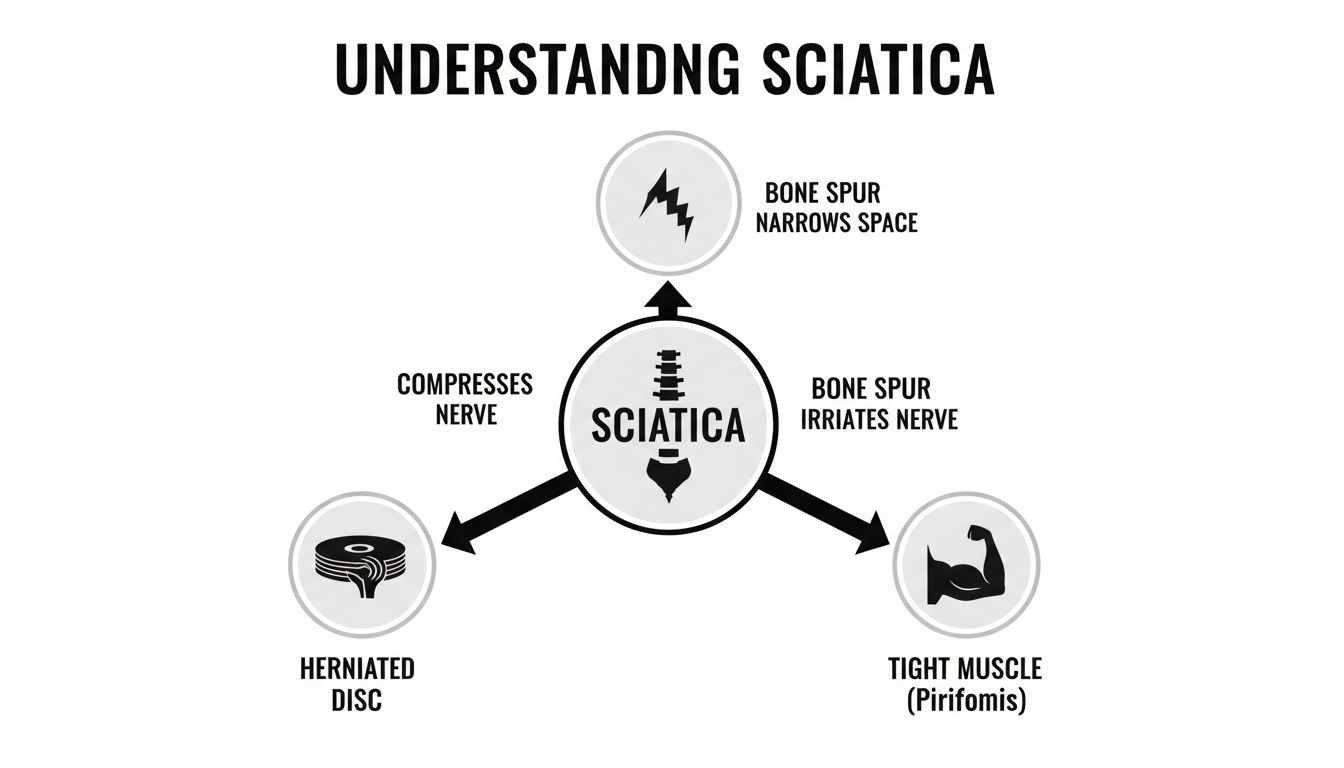
When you're dealing with the sharp, radiating pain of sciatica, the only question that matters is, "How do I make this stop?" At Peak Therapy, we understand this urgency. A licensed physical therapist doesn't just hand you a generic sheet of exercises; we create a strategic plan to tackle the specific cause of your nerve irritation and deliver lasting relief.
This isn't guesswork—it's a methodical, science-backed approach to healing. Our plans are built on three core principles that work together to calm the nerve, create more space for it, and build a strong foundation to prevent future flare-ups.
The Three Pillars of Sciatica Physical Therapy
- Goal 1: Centralization (Pain Retreat). Our immediate goal is to get the pain to retreat. We use specific movements to encourage the pain to "centralize," meaning it moves out of your leg and back toward its source in your lower back. This is an excellent sign that the nerve is decompressing.
- Goal 2: Decompression (Creating Space). Next, we focus on gently creating more room around the irritated sciatic nerve. This might involve hands-on techniques or specific exercises designed to ease pressure from a herniated disc, a tight muscle, or spinal stenosis.
- Goal 3: Stabilization (Building Protection). Finally, we work on strengthening the deep core and glute muscles. These muscles act as a natural brace for your spine. A strong, stable core protects your lower back from daily stresses, making you far less vulnerable to another episode.
As the diagram above shows, the nerve can be pinched by a disc, bone, or muscle, which is exactly why a one-size-fits-all approach just doesn’t work.
Evidence-Based Techniques for Real Results
To achieve these goals, we use proven, evidence-based methods. For instance, the McKenzie Method is a powerful assessment and treatment system that uses specific, repeated movements to identify which motions reduce and centralize your symptoms.
We also use nerve glides, which you can think of as gentle flossing for your nerves. These movements help the sciatic nerve slide more freely without getting caught on surrounding tissues. These active techniques are powerful because you become a partner in your own recovery, learning which movements bring relief.
Your therapist may also use other modalities to help manage acute pain. For example, using TENS for back pain relief is a common, non-invasive tool to manage discomfort from conditions like sciatica.
Your body has an incredible capacity to heal when given the right tools and guidance. Our job is to empower you with a plan that not only addresses the current problem but also protects you for the future.
This approach is backed by solid clinical evidence. A 2021 randomized trial showed that adults with recent-onset sciatica who received PT for just four weeks reported significant pain reduction and better physical function compared to those who only received standard care. This is why we often combine targeted exercises with hands-on treatments. Our guide on manual physical therapy explains how techniques like joint mobilization and soft tissue work can directly relieve pressure on the sciatic nerve and speed up your recovery.
What to Expect at Your First PT Visit for Sciatica

Taking that first step toward getting help can feel daunting, especially when you’re already in pain. You’re probably wondering what a physical therapist can really do for your sciatica. At Peak Therapy, your first visit is a clear, reassuring, and empowering experience.
This appointment is all about understanding your story. We don’t just want to know where it hurts; we need to know how that pain is affecting your life. Whether you're a commuter from Milton dealing with a miserable drive or a parent in Duxbury who can't keep up with the kids, we listen carefully to what matters most to you.
Your Comprehensive Evaluation
Your first appointment won’t involve jumping straight into a workout. It's a detailed investigation led by your physical therapist to get to the root cause of your sciatica.
The visit usually breaks down into three key parts:
- The Conversation: First, we listen. You’ll talk us through your symptoms, when they started, what makes them flare up or calm down, and how they’re getting in the way of your daily life. This conversation gives us critical clues about the source of your nerve pain.
- The Movement Assessment: Next, your therapist will guide you through a series of simple, controlled movements. We'll look at your posture, check your range of motion, and see how your body responds in different positions. This helps us spot the specific patterns causing nerve compression.
- Specialized Tests: Finally, we’ll perform a few targeted tests, like a straight leg raise or checks for muscle strength and reflexes. These are safe, gentle assessments that help us confirm the diagnosis and rule out other issues.
Think of this first visit as a fact-finding mission. You bring the expertise on how your body feels, and we bring the clinical expertise to connect the dots. Together, we build the foundation for your recovery.
Crafting Your Personalized Treatment Plan
By the end of your evaluation, you won’t be leaving with a generic handout of exercises. Your physical therapist will sit down with you and explain their findings in plain, easy-to-understand language. You'll know exactly what’s causing your sciatica and what our plan is to address it.
This personalized treatment plan is your roadmap back to feeling normal. It will include:
- Your Specific Goals: What do you want to get back to doing? Running a 5K? Gardening without pain? We design the entire plan around getting you to these milestones.
- Initial Interventions: We’ll start with gentle, targeted treatments designed to give you some immediate relief, such as hands-on manual therapy or specific movements to centralize your pain.
- A Clear Timeline: Your therapist will lay out the expected frequency and duration of your therapy, setting realistic expectations and goals along the way.
Taking action with physical therapy is a powerful move away from surgery. Research consistently shows that conservative approaches like PT have impressive success rates. In fact, one major study found 12-month success rates of 49% to 58% for patients with sciatica from a herniated disc who chose physical therapy. You can read the full research on physical therapy success rates to see how it helps people avoid more invasive options.
Examples of Common Physical Therapy Exercises for Sciatica
After a thorough evaluation, your physical therapist will create a plan that addresses the specific reason for your sciatica. The goal is never to hand you a generic list of stretches; it's about using targeted movements to relieve pressure on the nerve, improve your mobility, and build lasting strength.
While every plan is unique, it helps to understand the why behind the exercises we prescribe. Below are a few examples of evidence-based techniques we often use at Peak Therapy.
Important Disclaimer: Please do not try these exercises without a professional evaluation. The wrong movement for your specific condition can easily make sciatica pain worse. Always follow the guidance of a licensed physical therapist who can build a safe and effective program for you.
Exercises for Gentle Mobilization
The first step is usually to calm the irritated nerve. We do this with gentle movements designed to create space and help the nerve slide more freely.
- Sciatic Nerve Glide (Nerve Flossing): This gently “flosses” the sciatic nerve to help it move without getting caught on surrounding tissues. While lying on your back, you’ll bring one knee toward your chest. From there, you slowly straighten and bend the knee, which carefully mobilizes the nerve along its path.
- Press-Ups (Prone Press-Ups): This exercise is incredibly helpful if your sciatica is from a herniated disc. Lying on your stomach, you’ll place your hands under your shoulders and gently press your upper body up while keeping your hips on the floor. This encourages the bulging disc material to move away from the nerve root, often helping to "centralize" the pain out of your leg.
Stretches for Releasing Tight Muscles
Once acute pain settles down, your therapist may add stretches to loosen tight muscles that contribute to nerve compression. For many, tightness in the hips and hamstrings is a major factor.
- Piriformis Stretch: If a tight piriformis muscle is the culprit, this stretch can provide significant relief. While lying on your back with both knees bent, cross the ankle of your painful leg over the opposite knee and gently pull that thigh toward you. This targets the deep gluteal muscle that often presses on the sciatic nerve.
- Hamstring Stretch: Tight hamstrings can tug on your pelvis, increasing stress on the lower back. A safe way to stretch them is by lying on your back, looping a towel around one foot, and gently pulling the leg up until you feel a comfortable stretch along the back of your thigh.
Movements for Building Long-Term Stability
Lasting relief from sciatica depends on building a strong, stable support system for your spine. Strengthening your deep core and gluteal muscles creates a natural “corset” that protects your lower back from future strain. Learning how to engage these muscles correctly is why our physical therapists often include guidance from our guide on core strengthening exercises for your back.
Your program at Peak Therapy is always built around you, combining the best evidence-based techniques to get you back to living your life, pain-free. We often incorporate specialized approaches like Pilates for rehabilitation because it’s fantastic for building the deep core control and spinal stability needed for long-term sciatica recovery.
Your Partner in Sciatica Recovery on the South Shore
You don’t have to let sciatica pain dictate your life. At Peak Therapy, we’ve built our practice around providing a proven, safe, and effective path to getting your life back. We understand the frustration that comes with nerve pain, and our entire mission is to help you move freely and leave sciatica in the past.
We know that when you’re in pain, you need help now. That’s why we’ve made expert care accessible with convenient locations across the South Shore, from Plymouth to Quincy and Norwell to Hanover. Whether you're a commuter struggling with pain on Route 3 or an active resident trying to get back to the trails at Wompatuck State Park, we have a clinic nearby ready to help.
We Are More Than Just Therapists
At Peak, we blend clinical expertise with genuine, compassionate care. Our licensed physical therapists aren't just specialists in treating sciatica; they’re members of your community who are personally invested in your recovery. We see recovery as a team effort—you bring the commitment, and we’ll provide the expert guidance, hands-on treatment, and unwavering support you need to reach your goals.
Your recovery journey is unique, and your treatment plan should be too. We're committed to listening to your story, understanding your goals, and building a plan that gets you back to the life you love here on the South Shore.
From your very first evaluation to your final session, our focus is on empowering you. We’ll help you understand the real cause of your pain and give you the tools—the right exercises, better postural habits, and practical knowledge—to manage your condition and prevent future flare-ups. We celebrate every milestone with you, whether it’s sitting through a movie without pain or picking up your grandchild without a second thought.
Making Your Recovery Journey Seamless
Getting the care you need shouldn't be complicated. We make it easy to get started by allowing you to verify your insurance and schedule your first appointment online, removing any delays to starting your recovery.
You don’t have to face sciatica pain alone. Let our team at Peak Therapy help you build a stronger, more resilient, and pain-free future.
Your Questions About Sciatica and Physical Therapy, Answered
Even after learning how physical therapy can help with sciatica, it’s natural to have a few more questions. Wanting to be fully informed before starting your recovery journey is completely normal. We hear these questions all the time from our patients across Massachusetts, so we’ve put together some answers.
Our hope is to give you the clarity and confidence to take that first step. Think of your recovery as a partnership—and it all begins with feeling comfortable and knowledgeable about the process.
How Long Does Physical Therapy Take to Work for Sciatica?
This is usually the first thing people ask, and the honest answer is that everyone’s recovery timeline is different. That said, most patients begin to feel real relief within just a few weeks of starting a consistent program. Your progress will depend on what’s causing your sciatica, how long you’ve had symptoms, and how committed you are to your home exercises.
Here’s a general timeline many of our patients follow:
- Weeks 1-4: The focus is on reducing pain and inflammation. We use gentle techniques to take pressure off the nerve, and you’ll likely see a big improvement in your leg pain.
- Weeks 4-8: We shift toward restoring your mobility and function. As the pain calms down, we’ll introduce more exercises to improve your range of motion and start rebuilding your foundational strength.
- Weeks 8-12: The emphasis is now on building long-term strength and resilience. This phase is all about making your core and back strong enough to prevent sciatica from coming back.
Your therapist at Peak will work with you to set clear, personal milestones so you can see your progress every step of the way.
Can Physical Therapy Make Sciatica Worse?
When performed by a licensed physical therapist, it is extremely rare for PT to make sciatica worse. A huge part of your initial evaluation is to figure out the exact movements and positions that relieve your symptoms, not trigger them. Our therapists are trained to spot even the most subtle signs of nerve irritation and will immediately modify your plan if an exercise isn't right for you.
A core principle of safe sciatica treatment is to "do no harm." Any soreness after a session should feel like muscle fatigue from a good workout, not a return of that sharp, shooting nerve pain. This is exactly why professional guidance is so important.
The real risk comes from trying to treat it yourself with generic exercises from the internet. Without a proper diagnosis, you could easily do a movement that’s completely wrong for the cause of your sciatica, which might increase the pressure on the nerve and make things worse.
What if Physical Therapy Doesn’t Work for My Sciatica?
While physical therapy is highly successful for the vast majority of sciatica cases, we know that a small number of people may have an underlying issue that needs a different kind of treatment. Our licensed therapists are not just treatment experts; they're also skilled diagnosticians.
If your progress stalls or you aren't responding as we’d expect, your Peak therapist will:
- Re-evaluate your condition completely to see if anything has changed.
- Communicate openly with you about your progress and our clinical findings.
- Work directly with your primary care doctor or recommend you see a specialist for further imaging (like an MRI) or other options.
Your long-term health is what matters most. If PT isn't the whole solution, we will make sure you get on the right path to the care and relief you need.
Do I Need a Doctor's Referral for Sciatica PT in Massachusetts?
No! The great news for anyone in pain is that Massachusetts is a Direct Access state. This law means you can schedule an appointment directly with a licensed physical therapist without getting a referral from a physician first.
This lets you take control of your recovery and start feeling better faster. Our team of Doctors of Physical Therapy is fully qualified to perform a comprehensive evaluation, diagnose your condition, and determine if PT is the right path for you. If we spot any "red flag" symptoms that point to a more serious issue, we will immediately refer you to the right medical provider.
You don't have to spend another day wondering if physical therapy can fix your sciatica. Take the first step toward getting clear answers and lasting relief. The team at Peak Physical Therapy and Sports Performance is ready to build your personalized recovery plan. Schedule your evaluation online today and start your journey back to a pain-free life.