That run starts like any other. You head out on a Quincy side street, settle into a good pace, and a few miles later your knee starts talking back. Or your calf tightens on a Wompatuck trail. Or you finish an easy waterfront run on the South Shore and wake up the next morning wondering whether another workout will loosen things up or make the problem harder to calm down.
I see that pattern all the time with local runners. The hard part usually is not the first ache. It is the guesswork that follows. Should you rest, change shoes, shorten your stride, skip hills, or get it checked before a small issue turns into a month off from running?
Running is woven into daily life here. South Shore runners squeeze in early miles before work in Braintree, get out after school drop-off in Weymouth, train through Plymouth, and use beach roads, neighborhood loops, and rail trails year-round. When pain interrupts that routine, it affects more than fitness. Sleep gets worse. Stress goes up. Confidence drops every time you lace up.
Running physical therapy in South Shore, MA should do more than calm symptoms for a week. It should show you why the problem started, how your training and movement patterns are contributing, and what changes will be sustainable on the roads, trails, and shoreline routes you use every week. That local piece matters. A return-to-run plan for flat treadmill miles is different from a plan built for uneven trails, cambered roads, hills, and windy coastal runs.
Specialized running PT is available across the area, and the best care is specific to runners. That means looking at gait, strength, mobility, training load, footwear, recovery habits, and the surfaces you run on here at home. At Peak Physical Therapy, that is the difference we focus on. The goal is simple. Help South Shore runners get back to consistent miles with a body that can handle them.
Table of Contents
- Your Guide to Running Pain-Free on the South Shore
- Signs You Need a Running Physical Therapist
- What Is Specialized Running Physical Therapy
- Your First Running Assessment at Peak Physical Therapy
- Custom Treatment Plans to Get You Back on the Road
- Find Running Physical Therapy Near You on the South Shore
- Frequently Asked Questions About Running PT
Your Guide to Running Pain-Free on the South Shore
You finish a run along the beach in Duxbury or on the roads through Milton, and the pain does not feel serious enough to stop training. By the next run, it shows up again at nearly the same point. That pattern is common, and it usually means more than simple soreness.
Running pain tends to follow a load problem. Your tissues can handle part of the run, then they reach a threshold and start to react. I see this often with South Shore runners who are balancing road miles, uneven trails, hill work, and faster sessions in the same training block. The setting is local, but the mistake is familiar. Runners keep adjusting around the symptom instead of fixing the reason it keeps returning.
Local runners need more than generic advice from a search result. They need a plan that matches where they run, how often they train, and what their body does once fatigue sets in. A runner preparing for pavement miles in Quincy needs something different from a runner managing softer sand, side-sloped shoulders, or rooted trails farther south.
That is the value of specialized running physical therapy on the South Shore.
Instead of only chasing the painful spot, the work starts by connecting symptoms to mechanics, strength, mobility, and training load. Knee pain might be tied to hip control, stride timing, or a sudden jump in downhill running. Shin or calf pain might reflect ankle stiffness, poor loading through the foot, or a return to speed work that happened too fast. If knee symptoms are already becoming part of your routine, this guide to preventing runner's knee during training can help you spot common mistakes early.
Good rehab should also reflect the environment you are trying to return to. For South Shore runners, that can mean preparing for beach routes, neighborhood roads, trail footing, hills, and seasonal shifts that change both mileage and recovery. A clinic plan matters, but it has to carry over to the places you run.
What works best is usually straightforward:
- Identify the exact point when symptoms begin during or after a run
- Check the joints and muscle groups above and below the painful area
- Review running form and gait mechanics when needed
- Build strength and control that transfer to real running conditions
- Progress mileage and intensity at a rate the irritated tissue can handle
The goal is not to rest forever or guess your way back. The goal is to understand why your body is objecting, fix the limiting factors, and return to running with a plan that fits the South Shore routes you want to keep enjoying.
Signs You Need a Running Physical Therapist
If your body is changing your stride, it's time to stop guessing.
A lot of runners try to bargain with pain. They shorten the run, slow the pace, skip speed work, or tell themselves the soreness is just part of training. That can work for a brief flare-up. It doesn't work well when the same symptom keeps showing up and starts changing how you move.

Listen for these patterns
Certain signs usually mean you need more than rest, ice, or a few stretches from memory:
- Your pain shows up at the same point in every run: That repeatable trigger often points to a load tolerance problem, not bad luck.
- You're limping or shifting away from one side: Once pain alters your mechanics, you're not just running hurt. You're reinforcing compensation.
- Morning stiffness keeps hanging around: If the area still feels reactive the next day, the tissue likely isn't handling your current running volume.
- You keep having to "test it": If every run feels like an experiment, you need a plan instead of trial and error.
- The pain is spreading: A sore foot can become calf tightness, hip guarding, or back irritation when you keep adjusting around it.
What runners often get wrong
The biggest mistake is waiting for complete rest to solve a movement problem. Running injuries often improve slightly with reduced mileage, then return as soon as normal training resumes. That's especially true when your strength, balance, and control haven't caught up with the demands of impact.
Another common miss is treating symptoms too locally. If your kneecap hurts, you focus only on the knee. If your shin hurts, you only stretch the calf. Those choices aren't useless. They're just often incomplete. A more targeted look at patellofemoral symptoms can help, and this local guide to preventing runner's knee is a good place to start if your pain centers around the front of the knee.
The earlier you address a running injury, the easier it is to rebuild clean mechanics before compensation becomes your new normal.
When waiting gets expensive
Ignoring the signs usually costs you more running time, not less. It can also turn a manageable overuse issue into a longer interruption that affects walking, stairs, workouts, and confidence. If pain is making decisions for you, a running physical therapist should be making the plan instead.
What Is Specialized Running Physical Therapy
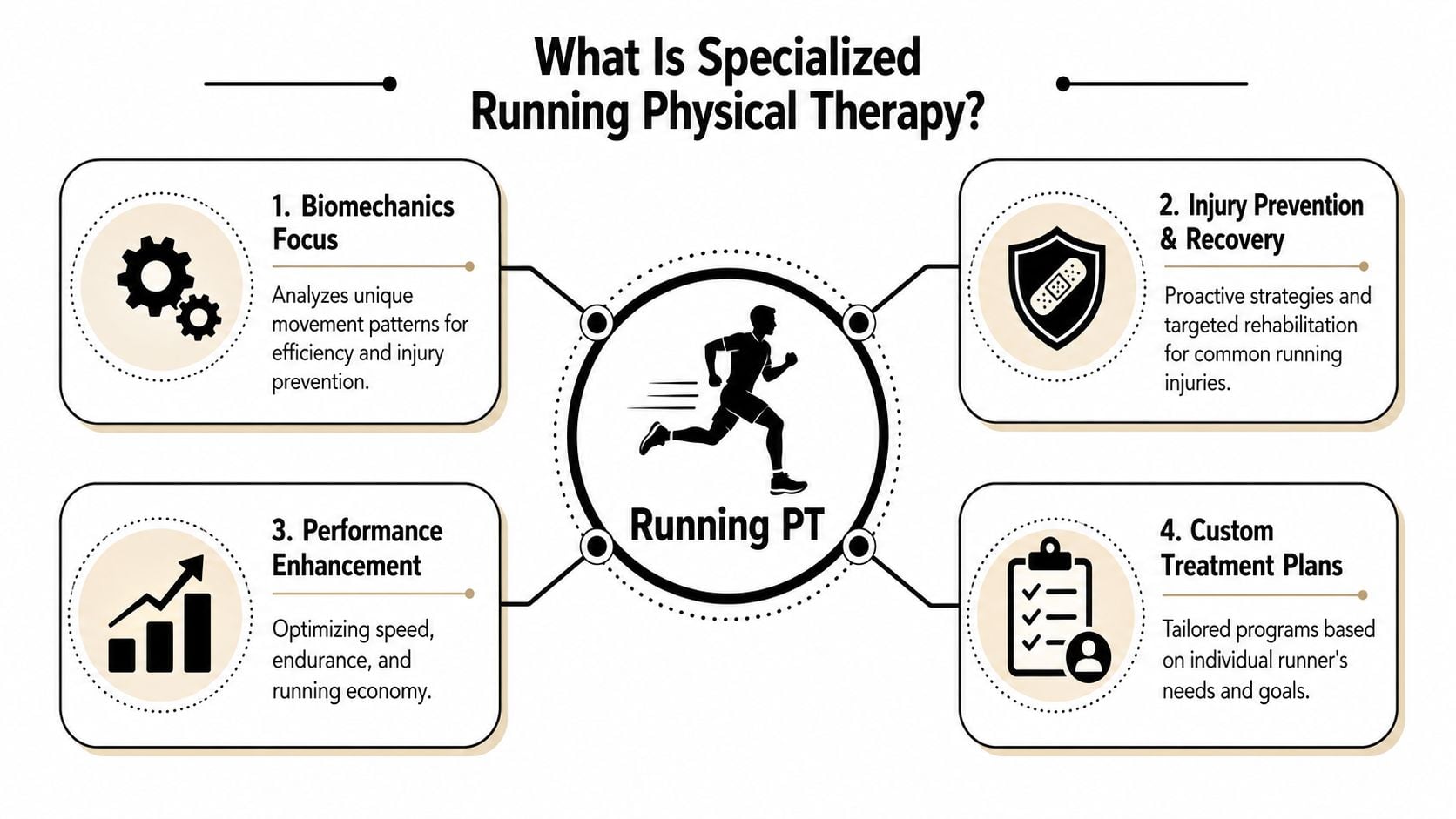
A runner from Hingham might feel fine on flat neighborhood roads, then flare up every time the route adds beach sand, bridge inclines, or the rolling sections around Wompatuck. That pattern matters. Specialized running physical therapy looks at how your body handles the specific demands of running here on the South Shore, not just whether a sore area hurts when you press on it.
It is a runner-focused evaluation and treatment process built around impact tolerance, single-leg control, tissue capacity, and running form under real load. The goal is to find why symptoms keep showing up during training, then fix the movement and strength problems that keep feeding them.
What makes it different from general PT
General rehab can help with pain, swelling, and early strength work. Specialized running PT goes further by asking running-specific questions. How do you load one leg at speed. What changes when fatigue sets in. Does your cadence, step width, trunk position, or push-off pattern increase stress on a knee, Achilles, shin, hip, or foot?
A proper running assessment often includes:
- Cadence and stride pattern: Overstriding, low cadence, or poor timing can raise stress in predictable places.
- Pelvic and trunk control: If the torso drifts or the pelvis drops, the leg below has to absorb force less efficiently.
- Foot and ankle mechanics: Limited ankle motion, poor calf strength, or unstable landing can change how force travels up the chain.
- Single-leg strength and balance: Running is repeated single-leg loading. Weakness usually shows up there first, not on a treatment table.
- Structural factors that may matter: If side-to-side differences seem relevant, a clinician may screen for them and use a guide to LLD assessment as part of broader clinical reasoning, not as a shortcut diagnosis.
In practice, that means the plan is built around the runner and the route. A South Shore runner training for a fall road race needs different progressions than someone returning to easy miles on the Marshfield rail trail or uneven coastal paths.
What it solves that rest does not
Rest can calm a tissue down. It does not build the capacity to handle the next run.
That is why specialized running PT is useful for patterns like these:
| Running problem | What often gets missed | What specialized PT looks for |
|---|---|---|
| Knee pain that returns with hills or longer runs | Focus stays only on the painful spot | Hip strength, step mechanics, downhill and incline tolerance |
| Shin or foot pain during mileage buildup | Shoes get blamed without checking loading | Calf endurance, impact pattern, training progression |
| Pain after surgery or childbirth | Return is based on time alone | Force tolerance, pelvic and core control, graded impact exposure |
| "I can jog, but I cannot really train" | Partial recovery gets treated like success | Capacity for volume, pace changes, uneven terrain, and recovery between runs |
There are trade-offs. A form change may reduce stress at the knee but ask more of the calf and Achilles. A runner may need to cut speed work for a few weeks to keep easy mileage. Sometimes the right answer is not stopping completely. It is adjusting frequency, terrain, and intensity while strength catches up.
The goal is a better-running body, not just lower pain
Pain relief matters, but it is not the whole target. Good running rehab should leave you more durable, more efficient, and more confident about building mileage again.
For South Shore runners, that usually means treatment that matches the places you run. Road camber, hills, sand, boardwalks, packed trails, and long flat stretches all load the body a little differently. Specialized running physical therapy accounts for that, so your return to running feels more stable when you're out on the trails or roads, not just inside the clinic.
Your First Running Assessment at Peak Physical Therapy
You finish a run on the South Shore feeling decent, then the knee or shin tightens up on the drive home. A few days later it happens again on the same hill, the same stretch of pavement, or the same long run route. By the time you book an evaluation, you usually want straight answers. What is irritated, why does it keep showing up, and can you keep running while it calms down?
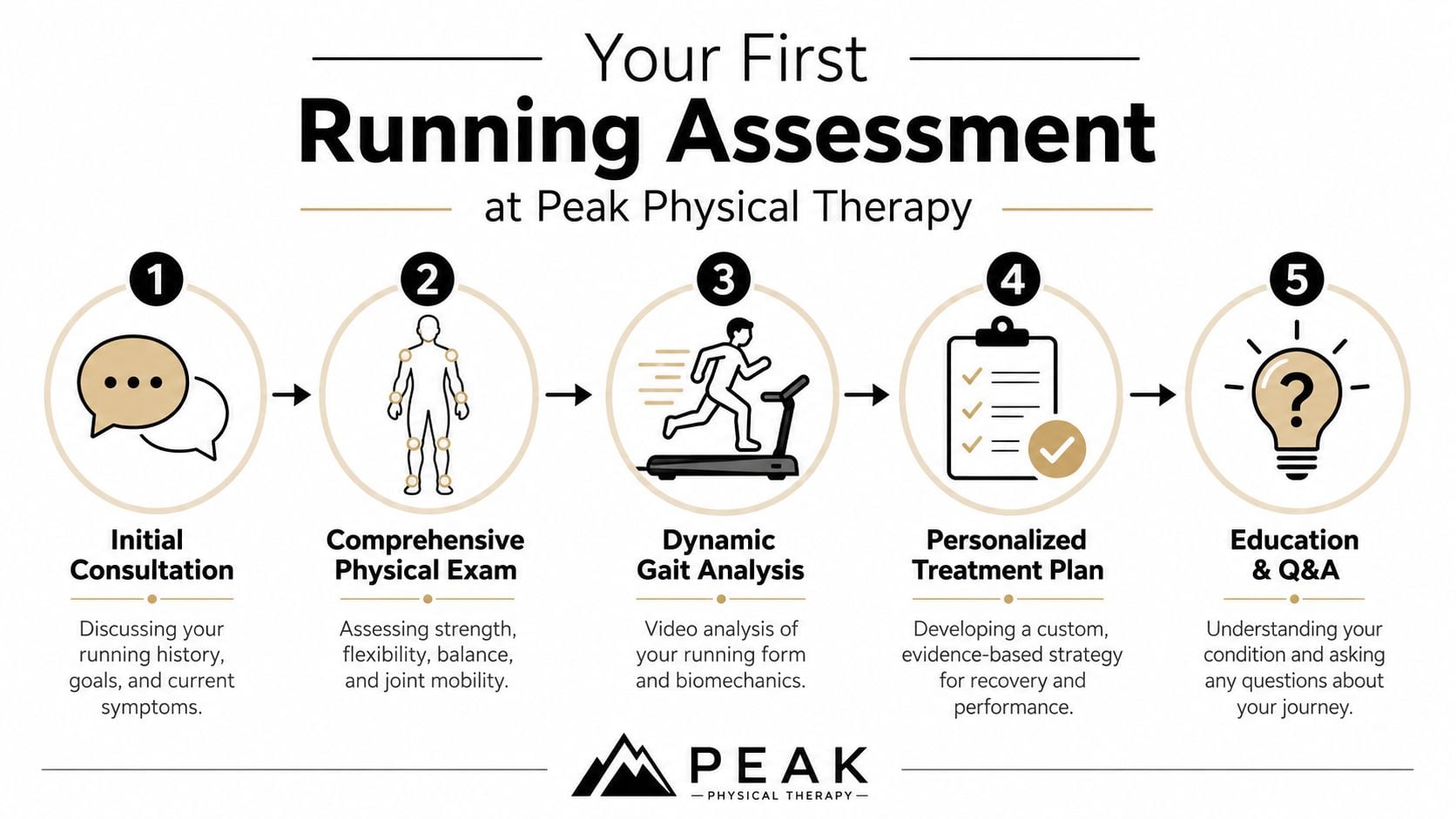
It starts with your running story
The first visit begins with your training, not just the body part that hurts.
We go through when the pain started, what changed around that time, and what your running week looks like. That includes mileage, pace, workouts, shoes, recovery, race goals, and where you tend to run around the South Shore. Road shoulders, beach access paths, packed trails, and long flat sections all change load in small but meaningful ways.
A runner training for a fall half marathon in Hingham needs a different conversation than someone trying to get back to easy 2-mile runs after a long layoff.
Then we test what your body can handle
After the history, the exam moves into movement and load testing. That may include range of motion, strength, balance, single-leg control, calf endurance, hop tolerance, and symptom checks that help narrow down what tissues are getting irritated and why.
Side-to-side differences can matter here, especially if one leg consistently takes more load. If you want background on that topic, this guide to LLD assessment gives a helpful plain-English overview.
We also watch you run.
At Peak Physical Therapy, video gait analysis often helps connect the dots between symptoms and mechanics. Sometimes the problem shows up right away. Sometimes it appears only after a few minutes, at a faster pace, or when fatigue sets in. A runner with knee pain may benefit from changes in step rate or hip control work, while another runner with the same pain needs better ankle mobility or stronger calf capacity. For runners dealing with that pattern, these knee pain exercises for runners can give useful context alongside the in-person assessment.
What you should leave with
You should leave the first visit with a working plan, not a vague list of possibilities.
That plan should explain what we found, what is most likely driving the pain, and what you can safely do this week. In many cases, that includes some running. In other cases, we trim hills, speed, or total volume for a short period so the irritated area can settle while you build the strength and control that have been missing.
Clear answers matter. You should know:
- What running is safe right now
- What activities or workouts need to change for the moment
- What markers tell us you are ready to progress
That kind of clarity usually lowers a lot of stress. Runners do better when they understand the trade-offs and know exactly how the return-to-run process will be handled in their own community, on the roads, trails, and shoreline routes they use.
Custom Treatment Plans to Get You Back on the Road
You finish a run along the shore feeling decent, then your Achilles tightens up that night, or your knee starts talking back the next morning on the stairs. That pattern matters. A useful treatment plan is built around how your symptoms respond to load, the surfaces you run on here, and the kind of mileage you want to return to.
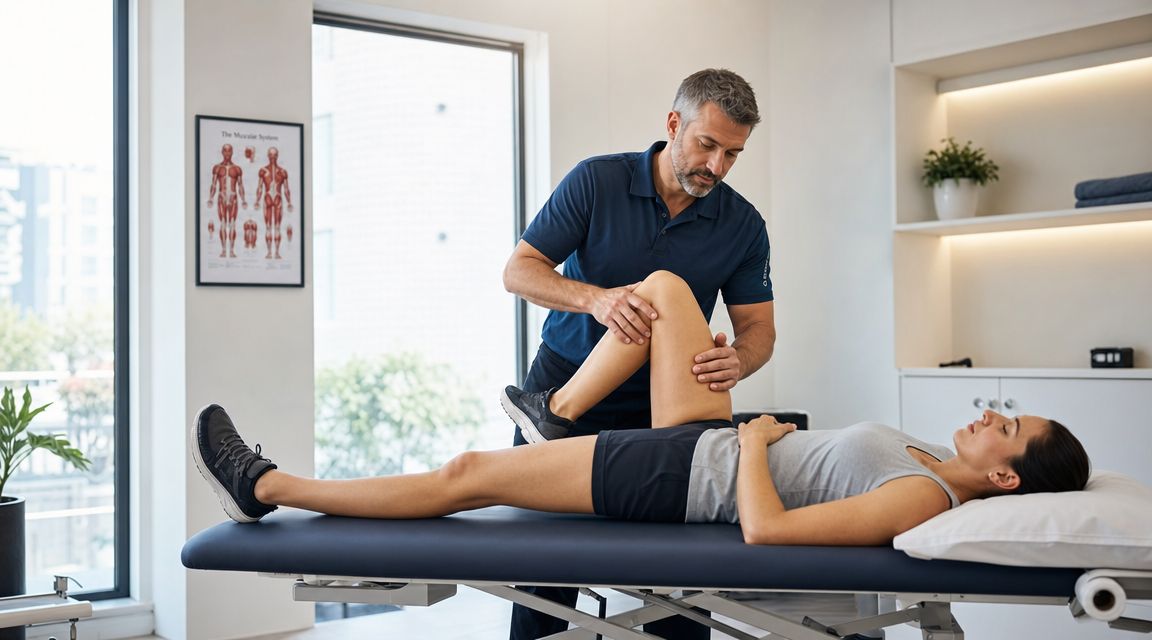
A South Shore runner training for local road races needs a different plan than someone easing back onto beach paths, rebuilding after pregnancy, or returning after a procedure. The body part that hurts is only part of the picture. I look at the irritated tissue, the strength and mobility limits around it, and the amount of running your system can handle right now without paying for it the next day.
What treatment often includes
Runner rehab usually uses several pieces that work together.
- Hands-on treatment: Used to calm symptoms, improve joint or soft tissue mobility, and make movement feel less restricted.
- Targeted strength work: Exercises match the weak link. Sometimes that is calf capacity for Achilles pain. Sometimes it is hip and trunk control. Sometimes it is foot and ankle strength for runners who struggle on uneven ground.
- Neuromuscular retraining: Strength only helps if you can use it while landing, pushing off, and controlling single-leg stance.
- Return-to-run progressions: Running volume, impact, pace, and terrain come back in an order that fits your symptoms and goals.
The trade-off is straightforward. Progress too slowly and runners lose conditioning and confidence. Progress too fast and the same tissue gets irritated again before it has built enough capacity.
What tends to work best
Gradual exposure works. The goal is to keep enough running in the plan to maintain rhythm, while adjusting the parts your body is not tolerating yet.
For one runner, that means flat routes instead of hills through Hingham or Quincy. For another, it means shorter runs on the road before getting back to trails in Wompatuck or softer sand near the beach. We also use clear response markers. Pain during the run, soreness later that day, and stiffness the next morning all help decide whether to hold, progress, or pull back.
Runners often run into trouble when they treat one good day as proof that everything is fixed. The opposite problem happens too. Some stop all impact for too long, then struggle to restart because their capacity dropped.
How a return-to-run plan should feel
A good progression feels controlled and repeatable.
That usually means:
- Building tolerance for walking, hopping, or short impact drills first.
- Starting with brief run intervals and specific symptom rules.
- Increasing total volume before adding speed workouts.
- Bringing back hills, longer efforts, and uneven surfaces after the basics are solid.
That matters even more for runners over 35, postpartum runners, and anyone coming back after a long layoff. These runners often do well with clear strength targets, recovery guidelines, and a little more patience between jumps in training load.
If knee symptoms are part of the picture, our guide to knee pain exercises for runners can help between visits. The larger goal is a plan that fits your real routes, your real schedule, and the kind of running you want to keep doing on the South Shore.
Find Running Physical Therapy Near You on the South Shore
You finish a run on the beach in Duxbury or along the roads in Quincy, and by the time you get home, that familiar ache is back. At that point, location matters. If care is close to home, work, or the route you run every week, it is much easier to stay consistent, make timely changes, and keep training from sliding backward.
That is part of what makes local running physical therapy different on the South Shore. Care should fit the places you run and the schedule you keep. A runner training for neighborhood 5Ks needs something different from a parent squeezing in early miles before work, and both benefit from a clinic that understands local roads, hills, trails, and seasonal surfaces.
South Shore locations where you can find care
Peak Physical Therapy and Sports Performance serves runners across the South Shore, with locations in:
- Braintree
- Quincy
- Weymouth
- Cohasset
- Duxbury
- East Bridgewater
- Hanover
- Kingston
- Milton
- Norwell
- Pembroke
- Plymouth
- Scituate
If Braintree is the easiest fit for your commute or training schedule, you can start with the Braintree physical therapy clinic page to book a visit.
A nearby clinic does more than save drive time. It gives you a realistic way to follow through with gait analysis, strength progressions, mobility work, and return-to-run check-ins without turning rehab into another obstacle. That matters for South Shore runners who are balancing work, family, and training through changing weather and mixed terrain.
Peak Physical Therapy and Sports Performance offers runner-focused care, post-surgical rehab, and sports injury treatment across these communities. The goal is straightforward. Get evaluated close to where you live, understand what is driving the pain, and build a plan that matches the roads, trails, and race goals that matter to you.
If your running has started to feel like a cycle of rest, test, flare-up, and repeat, local support can make the process much more manageable.
Frequently Asked Questions About Running PT
A lot of South Shore runners ask the same thing after a pain flare starts changing their week. Can I keep running, do I need a referral, and how long is this going to take?
Do I need a doctor's referral to start physical therapy in Massachusetts
Many runners can start physical therapy through direct access. Insurance rules can still vary, so the practical first step is to call the clinic and confirm what your plan requires before the first visit.
How long does it take to get back to running
Return-to-run timelines depend on what is driving the pain. A newer calf strain, persistent knee pain, bone stress issue, or post-surgical recovery all follow different timelines.
I look at tissue irritability, strength, single-leg control, training history, and how symptoms respond during the next 24 hours. That gives us a safer way to build mileage back in. The goal is not to pick a date and hope for the best. The goal is to earn each step back with clear progress markers.
I'm just a casual jogger. Is this still for me
Yes.
Running physical therapy helps the runner training for a half marathon and the parent trying to get back to three miles after work. The treatment approach still matters because the same problems show up in both groups: overload, poor recovery, stiffness, weakness, and changes in form that start as small compensations and turn into recurring pain.
Casual runners often do especially well with a focused plan because a few targeted changes can make running feel good again without overcomplicating training.
Should I stop running completely before my evaluation
Not always. Some runners need a short break, especially if pain is sharp, worsening, or causing a clear limp. Others can keep running with changes to pace, distance, hills, surface, or weekly frequency until the evaluation.
A good rule is simple. If your stride is changing, pain is climbing as the run goes on, or symptoms are noticeably worse later that day or the next morning, scale back and get assessed soon.
If running pain is changing your stride, your schedule, or your confidence, Peak Physical Therapy and Sports Performance can help you get a clear local plan. Book an appointment at a South Shore clinic near you to start with a one-on-one evaluation, review your running mechanics, and build a return-to-run program that fits your goals.